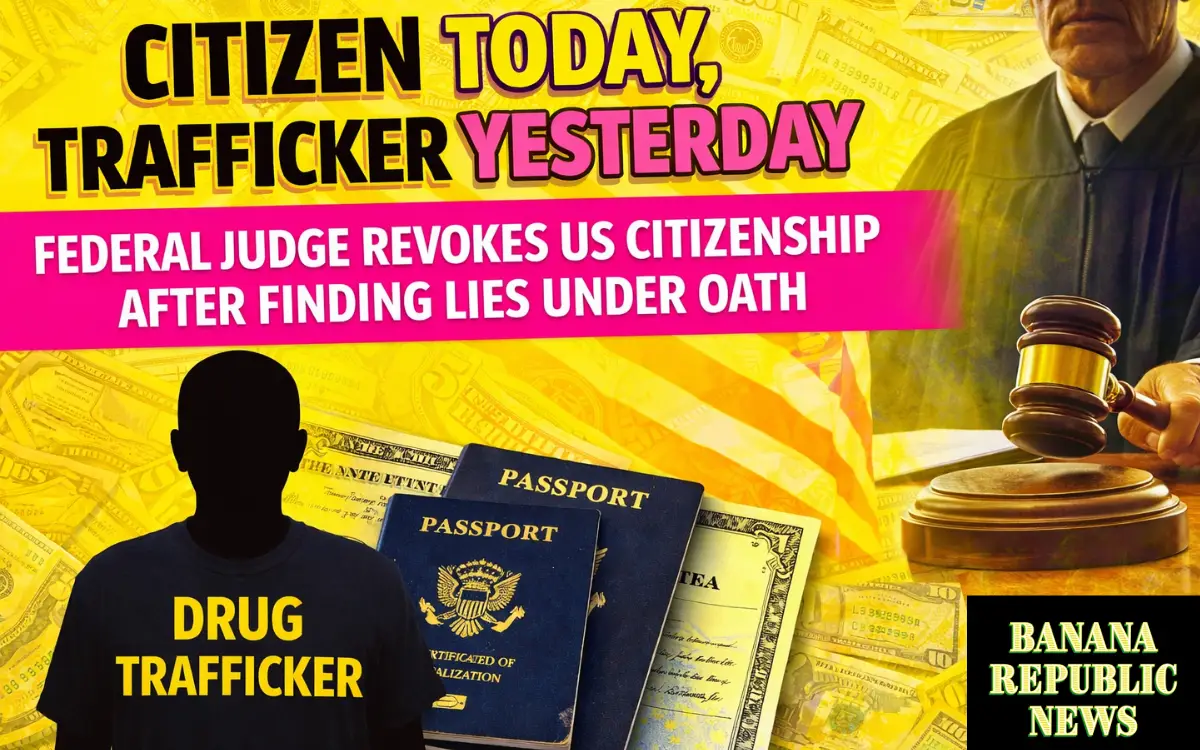
In a decision that reads less like a routine court order and more like a credibility autopsy, a federal judge in the Northern District of Florida has officially revoked the U.S. citizenship of Melchor Munoz — concluding that his path to citizenship was built on statements the court ultimately did not believe.
According to the Court’s Final Order, the issue was deceptively simple:
“The only issue is whether Munoz’s drug trafficking began before his naturalization or after it.”
The answer, after trial, was not in doubt.
The Timeline That Undid Citizenship
Munoz became a U.S. citizen in September 2009. But federal prosecutors argued — and the court ultimately agreed — that his involvement in drug trafficking began before that date, making him legally ineligible for naturalization in the first place.
The court stated plainly:
“I conclude the government met its burden of proving that Munoz did, in fact, engage in drug trafficking before his 2009 naturalization.”
That matters because U.S. law requires “good moral character” during the naturalization period — a requirement the court emphasized is not optional:
“There must be strict compliance with the statutory prerequisites to naturalization.”
And drug trafficking, unsurprisingly, does not qualify.
The Problem: The Defendant’s Own Words
The case didn’t hinge on some hidden surveillance or secret witness. It hinged largely on Munoz’s own prior statements — including sworn testimony.
At his plea hearing, Munoz stated:
“Late 2008 I started getting… marijuana.”
Later, he tried to walk that back, arguing he was mistaken, confused, pressured — take your pick.
The court was not persuaded.
The Court’s Core Finding: Not Credible
In one of the more blunt sections of the order, the judge dismantled Munoz’s testimony point by point, concluding:
“I found his testimony not credible.”
And it didn’t stop there.
The court described his testimony as:
“Evasive and did not answer questions directly.”
Even more damaging, the judge explained that inconsistent explanations only made things worse:
“Munoz’s inability to land on one explanation… evidences a calculated approach to see what sticks.”
Translation: the story kept changing — and not in a way that inspires confidence.
When Testimony Backfires
In a twist that should make any defense attorney nervous, the court noted that Munoz’s own lack of credibility actually worked against him as evidence:
“A factfinder can use a witness’s noncredible testimony as corroborating substantive evidence against the witness’s interests.”
In other words: if the court doesn’t believe you, that disbelief itself can help prove the case against you.
That’s not a legal technicality — that’s a problem.
Final Blow: Citizenship Revoked
After reviewing the evidence, the court issued a decisive conclusion:
“The government has shown that Munoz illegally procured his citizenship.”
And then, the consequence:
“The order admitting Munoz to United States citizenship is REVOKED and SET ASIDE.”
Not suspended. Not questioned. Revoked.
The court further ordered that he is:
“Forever restrained and enjoined from claiming any rights, privileges, benefits, or advantages” of U.S. citizenship.
The Bigger Picture (Yes, This Is Happening)
Cases like this are rare — but they are increasing.
Denaturalization is one of the most serious civil actions the federal government can take. It requires what courts describe as:
“Clear, unequivocal, and convincing evidence… not leave the issue in doubt.”
That is a high bar. And in this case, the court found it was met.
Final Thought (Banana Republic News Translation)
This case wasn’t about paperwork errors or bureaucratic confusion.
It came down to one core issue:
👉 What was said under oath — and whether the court believed it.
Spoiler: it didn’t.
🚨 CALL TO ACTION: HOW THE PUBLIC CAN REPORT IMMIGRATION FRAUD OR RELATED ACTIVITY
If you believe someone may have:
-
Lied during the naturalization process
-
Used fraudulent documents
-
Engaged in criminal activity tied to immigration status
There are legitimate federal reporting channels — no need to guess.
1. ICE Homeland Security Investigations (HSI Tip Line)
-
Phone: 1-866-DHS-2-ICE
2. USCIS Fraud Detection & National Security (FDNS)
3. Department of Justice (DOJ)
4. Local Law Enforcement (If Immediate Concern)
-
Especially for ongoing criminal activity tied to trafficking or violence, you should also report the issues to your local municipal policing agency.
⚖️ Important Note
Reporting should be based on specific facts or credible observations, not assumptions or personal disputes. False reporting can carry consequences.
🏁 Bottom Line
This case shows something simple — and uncomfortable:
When the system actually follows through,
citizenship obtained under false pretenses can be undone.
Even years later.